Moving from the nineteenth-century Pearl River estuary port and twentieth-century Guangzhou neighborhood customs to Cantonese-inflected long fiction, Indonesian and Thai Sinophone writers' memories of studying in or revisiting Guangzhou, Spring Festival migrant-worker rail journeys, and transnational marketplaces in Xiaobei and Sanyuanli—paired with historical qiaoxiang field research for boundary contrast—this selection traces Guangzhou as Lingnan metropolis, diaspora transit hub, and Global South trading crossroads.
The urban literary space of Guangzhou, China; character memories, hospital-visit scenes, and authors' places of composition are recorded separately, without equating hospitals named in fiction with real-world institutions.
Works on this page · 8
All selected works
Explore each work’s connection to a place, with reading reasons and sources.
A foundational Cantonese-inflected vernacular novel tracing three neighboring families—blacksmith, comprador, and landlord-official—in a 1920s Guangzhou lane amid the Canton–Hong Kong Strike, weaving Cantonese idioms, teahouse life, and seasonal customs into modern narrative. Editors pair it chronologically with Tide Chart's nineteenth-century estuary; curated from library records and published commentary without full-text reading, and fictionalized lanes are not treated as municipal history.
Set across early nineteenth-century Tanka boat waters on the Pearl River, the Canton Thirteen Factories, and Macau's Casa Garden, Lin Zhao's contemporary novel adopts the fantastical voice of a giant female frog to braid Cantonese vernacular texture, early Cantonese-English lexicons, export painting, and natural history. Editors pair its pre-Opium War contact zone with Three-Family Lane and The World in Guangzhou; selected from catalog records, publisher notes, and literary criticism without full-text reading, and fantastical allegory is not taken as treaty-port fact.
Sino-Indonesian writer Yuan Ni's short story opens directly with visiting a critically ill friend in a Guangzhou hospital and walking Guangzhou's streets before flying back to Jakarta, using half a packet of melon seeds to trace overseas Chinese school closures and decades of cross-sea separation between Indonesia and returnees in Guangzhou. Verified from the publicly accessible full text; fictional narrative is not generalized as a comprehensive history of returnees.
Within an elderly protagonist's life along Bangkok's Chao Phraya River, Sino-Thai writer Wen Xiaoyun embeds memories of university days in Guangzhou before transiting through Macau to Thailand, written in prose rich with Cantonese and southern vernacular cadence. Curators include this specific story rather than the full Thai-Chinese anthology Across the Sea so as not to misattribute Bangkok-only stories to Guangzhou; verified from the open-access digitized text.
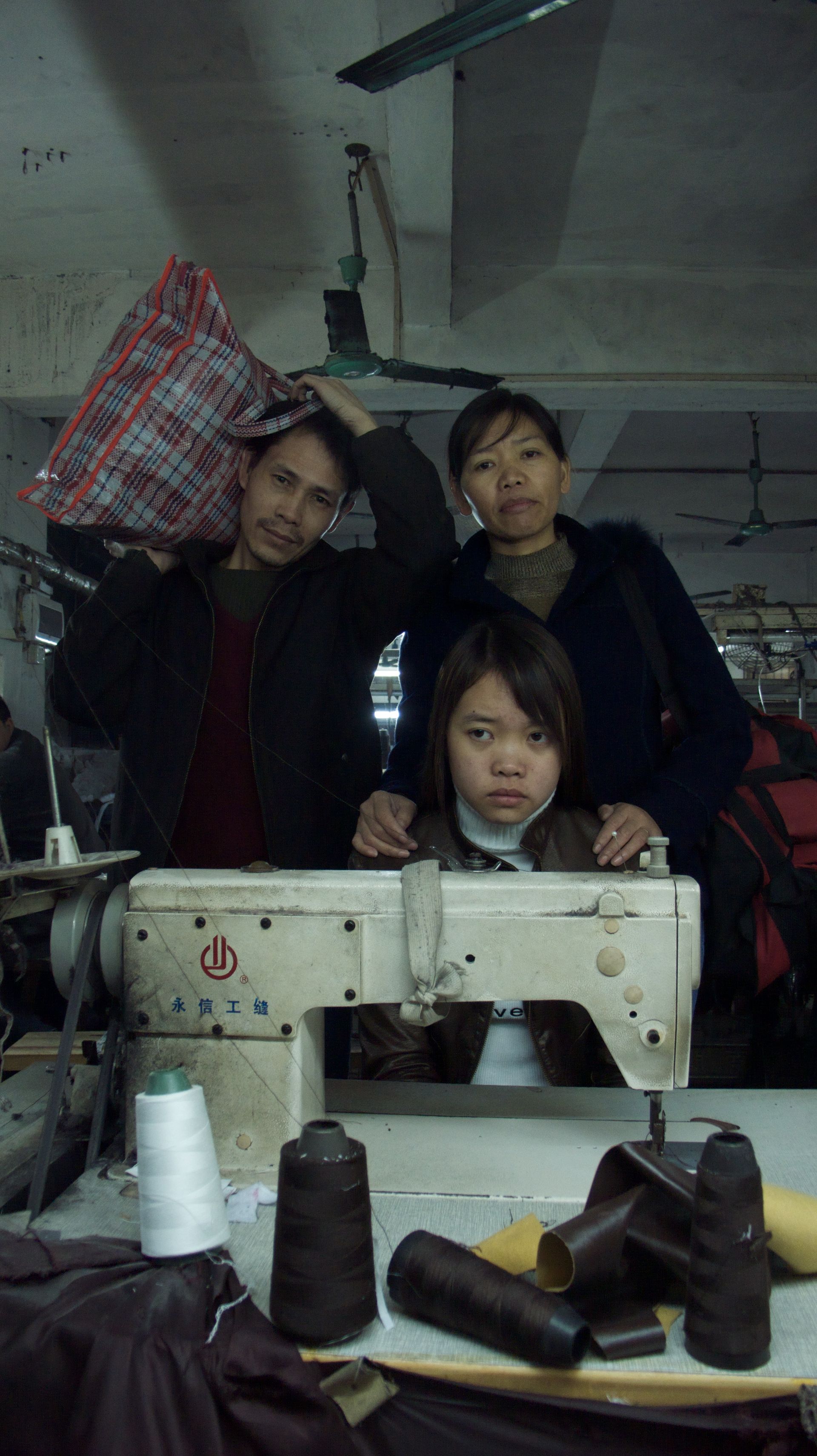
Fan Lixin's documentary follows a Sichuan migrant couple working year-round in a Guangzhou garment factory and braving massive Spring Festival crowds at Guangzhou Railway Station to return home, capturing the multilingual soundscape of internal labor migration behind Pearl River Delta manufacturing. Editors pair it with the transnational trading circuits in The World in Guangzhou; curated from TIDF and IDFA festival records without viewing the full film.
Book · · Gordon Mathews · Linessa Dan Lin · Yang Yang
An ethnographic monograph by Gordon Mathews, Linessa Dan Lin, and Yang Yang (with a Chinese edition from CUHK Press) examining how African and foreign traders, Chinese suppliers, brokers, and mixed couples conduct "low-end globalization" commerce in Guangzhou's Xiaobei and Sanyuanli neighborhoods—reframing Guangzhou as an inbound transnational hub rather than solely a historic emigrant departure port. Selected from publisher records and the open Chinese sample chapter without reading the full book; ethnographic cases are not extrapolated as current visa law or citywide demographics.
Sociologist Chen Ta's landmark 1934 field investigation of Fujian and eastern Guangdong qiaoxiang communities (1938 Commercial Press Chinese edition; 1940 English edition Emigrant Communities in South China) provides social-historical context for Nanyang migration, remittances, and returnee households behind Yuan Ni's and Wen Xiaoyun's stories, while clarifying the analytical boundary between rural Guangdong emigrant sending districts (such as Chaoshan and Wuyi) and metropolitan Guangzhou itself. Curated from publisher and library catalogs without full-text reading.
Cantonese teahouse culinary lineage and century-spanning Lingnan novel selection: first published in 2022 and winner of the 10th Dream of the Red Chamber Award (2024), Ge Liang's Food Is Heaven opens at Guangzhou's Tongqinlou teahouse in the 1920s, tracing dim sum master Rong Yisheng and apprentice Chen Wuju across a century of Guangzhou street life and migration to Hong Kong; pairs across eras with Three-Family Lane and Tide Chart.
Focused on the municipality of Guangzhou at the northern apex of the Pearl River Delta—covering urban neighborhood life, Cantonese-inflected and Mandarin Sinophone writing, Nanyang returnee memories of back-and-forth movement, and post-reform intersections of internal migrant workers and transnational trading communities. It excludes Wuyi (Taishan, Kaiping, Enping, Xinhui), Chaoshan, and Meizhou emigrant hinterlands in Guangdong, and remains explicitly distinct from the Hong Kong and Macau entries.
Reference points indicate location, not the extent of this selection.