Begin with a Chợ Lớn culinary essay on District 5 neighborhood memory, explore contemporary four-line verse across thirteen poets in Selected Vietnamese-Chinese Truncated Verses, contrast southern experiences with Hsu Wen-tang's study of Hanoi's Hàng Ngang quarter and northern Vietnam's postwar Chinese communities, and connect wartime and diasporic perspectives through The Nanyang Reader and modern poetry histories.
Country-level scope of Vietnam where explicitly named in work sources; specific cities and periods require separate work-level evidence, without extending a narrative across all Mekong riparian states on the basis of "Mekong" in a title.
The local landscape of Cholon (Chợ Lớn) as referred to in the original publication, with specific streets, District 5, and restaurant histories understood in the context of the 2019 text rather than equating historical quarter names with present-day administrative boundaries.
The urban historical and Sinophone community research space of Hanoi, Vietnam—including historic Old Quarter merchant streets such as Hàng Ngang and former guild-temple sites; kept distinct in scale from Chợ Lớn in southern Vietnam and from Vietnam nationwide, without equating historical enclave patterns with present-day municipal conditions.
Works on this page · 4
All selected works
Explore each work’s connection to a place, with reading reasons and sources.
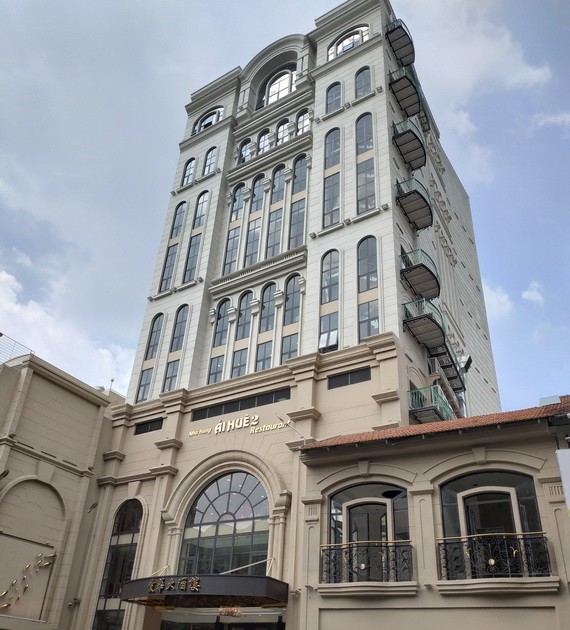
Directly accessible local essay: enter Chợ Lớn life through tea houses, musical dim sum halls, and the succession of restaurants, noticing how shop names thread together neighborhood memory. Based on reading the full text on the newspaper's website; business status as of 2019 is not a current dining recommendation, and historical details have not been independently verified item by item.
Modern Vietnamese-Chinese short-verse anthology: edited by Lin Xiaodong in Showwe's Taiwan Poetics "Truncated Verse" series, this first Taiwan anthology of Sinophone Vietnamese poets gathers four-line-or-shorter poems across thirteen writers of three generations—including Chợ Lớn poetry-society veterans alongside younger voices—and pairs naturally with its sister volume Selected Myanmar-Chinese Truncated Verses; curated from NBINet and publisher records without reading all poems in full, without treating overseas diasporic pieces as local scenes inside Vietnam.
Historical-demographic perspective on Hanoi and northern Vietnam: extending the view northward beyond Chợ Lớn, Hsu Wen-tang combines historical traces from Hanoi's Hàng Ngang merchant street and its Guan Di temple with Vietnamese census data (1979–2009) to explain the contraction of northern Hoa communities after the First Indochina War, the 1954 southward exodus, socialist transformation, and shifting ethnic boundaries among Hoa, Nùng, Ngái, and Sán Dìu groups. Curated from Academia Sinica's Asia-Pacific Research Forum metadata and abstract to contextualize North–South differences.
Cover via Google Books · 麥田, ISBN 9786263103078. Image rights remain with their holders; this service link is not an open licence or permission to mirror the image.
Edited volume · · Editor David Der-wei Wang · Editor Ko Chia-cian
Cross-regional Nanyang anthology context: Part I ("Peninsula") excerpts Pan Lei's Red River novel Quiet Flows the Red River, while Part IV ("Islands") gathers Vietnamese-Chinese modernist poems by Yin Fa and Yao He alongside Lo Fu's Saigon wartime cycle, situating wartime northern and southern Vietnam within a wider Southeast Asian Sinophone literary frame. Selected from library cataloging and published tables of contents without reading all chapters in full.
A local newspaper book notice introducing the author and her old Chợ Lớn subjects, offering a starting point for locating her essay collection. The publisher, colophon, and full table of contents have not yet been obtained, nor is it confirmed whether the essay selected on this page is included; the news item is not the full book text.
Audience recollections in a local newspaper report open onto the circulation of Sinophone cinema, Cantonese opera, and Teochew opera, offering cultural context alongside the culinary essay. Historical claims and personal anecdotes in the report have not been independently verified item by item, nor does it serve as a directory of currently operating cinemas.
Revised from Paris-based Sino-Vietnamese poet Fang Ming's Tamkang University master's thesis (Taipei: Tonsan Publications, 2014), this monograph traces poetry societies and antiwar modernist verse in Saigon / Chợ Lớn between 1960 and 1975 under the twin pressures of war and Taiwanese modernist poetics, bridging Selected Vietnamese-Chinese Truncated Verses and the poems by Yin Fa and Yao He in The Nanyang Reader; listed as an uncataloged reference lead without a full reading.
Opens with Chợ Lớn tea-house memories and local Chinese-language press culture, then expands to the 13-poet anthology Selected Vietnamese-Chinese Truncated Verses, postwar scholarship on Chinese communities in Hanoi and northern Vietnam, and Red River and wartime Saigon selections in The Nanyang Reader; while spanning southern Chợ Lớn and northern Hanoi, it does not represent all provinces of Vietnam or Vietnamese-language literature as a whole.
Reference points indicate location, not the extent of this selection.